Treap data structure
Updated Nov 03, 2022
A Treap is a data structure that mantains a dynamic set of ordered keys and allows binary searches among the keys. In a treap, after a sequence of insertion and deletions, the height of the tree is with high probability proportional to the logarithm of the number of keys. This allows each insertion, search or deletion to take logarithmic time to perform.
The key idea of treaps is that if n elements are inserted in a binary tree in random order then the expected depth is $1.39 log{n}$. The way this is done is assigning a random priority to every element in the tree and enforcing the binary search tree properties to the keys and the min-heap properties to the priorities. (Treap = Tree + Heap).
In particular:
- For every element x, y (search tree property):
- elements y in the left subtree of x satisfy: key(y) < key(x)
- elements y in the right subtree of x satisfy : key(y) > key(x)
- For every element x, y (heap property):
- If y is a child of x, then prio(y) > prio(x).
- All priorities are pairwise distinct.
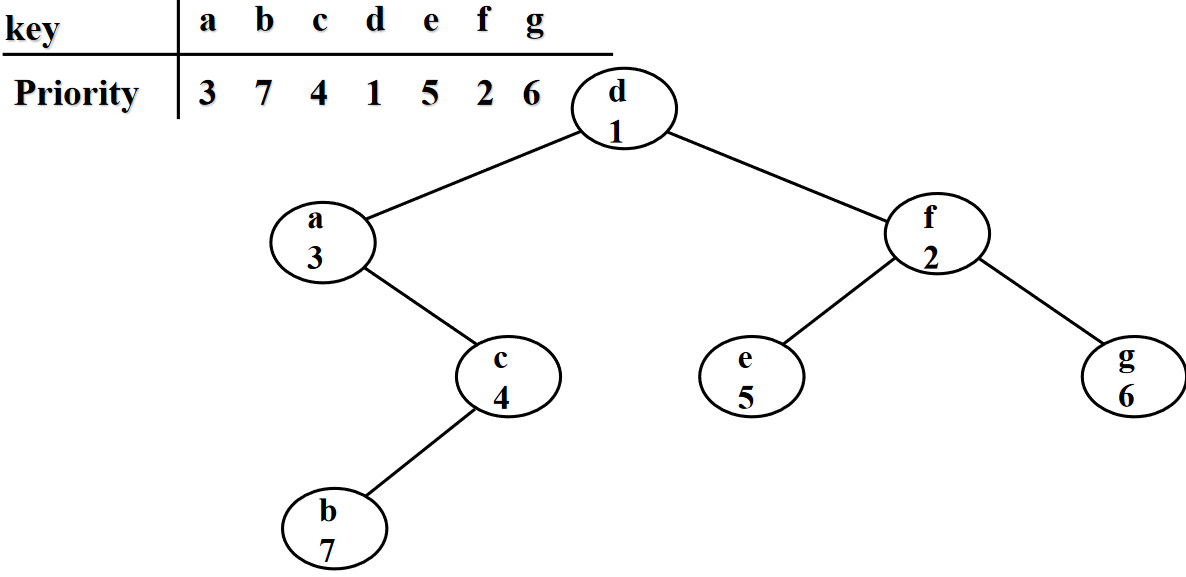
An equivalent way of describing the treap is that it could be formed by inserting the nodes highest priority-first into a binary search tree without doing any rebalancing. Therefore, if the priorities are independent random numbers (from a distribution over a large enough space of possible priorities to ensure that two nodes are very unlikely to have the same priority) then the shape of a treap has the same probability distribution as the shape of a random binary search tree, a search tree formed by inserting the nodes without rebalancing in a randomly chosen insertion order. Because random binary search trees are known to have logarithmic height with high probability, the same is true for treaps.
Treap uniqueness
For elements x1, ... , xn with key(xi) and prio(xi), there exists a unique treap.
The proof is done by induction:
- $n=1$ OK
- $n > 1$:
- The root has the smallest priority (k1,p1)
- All the elements y with key(y) < k1 go on the left subtree
- All the elements y with key(y) > k1 go on the right subtree
Treap operations
Insert new key x
Insert(x):
  Choose prio(x).
  Search for the position of x in the tree.
  Insert x as a leaf.
  Restore the heap property.
    while prio(parent(x)) > prio(x) do
      if x is left child then
          RotateRight(parent(x))
      else
          RotateLeft(parent(x));
      endif
    endwhile;
To insert a new key x into the treap, generate a random priority prio(x) for x. Binary search for x in the tree, and create a new node at the leaf position where the binary search determines a node for x should exist. Then, as long as x is not the root of the tree and has a larger priority number than its parent z, perform a tree rotation that reverses the parent-child relation between x and z.
Delete key x
Delete(x):
  Find x in the tree.
  while x is not a leaf do
    u := child with smaller priority;
    if u is left child then
        RotateRight(x))
    else
        RotateLeft(x);
    endif;
  endwhile;
  Delete x;
To delete a node x from the treap, if x is a leaf of the tree, simply remove it. If x has a single child z, remove x from the tree and make z be the child of the parent of x (or make z the root of the tree if x had no parent). Finally, if x has two children, swap its position in the tree with the position of its immediate successor z in the sorted order, resulting in one of the previous cases. In this final case, the swap may violate the heap-ordering property for z, so additional rotations may need to be performed to restore this property.
The expected running time delete operation is $O(log n)$. The expected number of rotations is 2.
Split
Split $T$ into $T_1$ and $T_2$: $$Split(T,k,T_1,T_2): \forall x_1 \in T_1, x_2 \in T_2: key(x_1) \le k and k < key(x_2)$$
To split a treap into two smaller treaps, those smaller than key x, and those larger than key x, insert x into the treap with minimum priority. After this insertion, x will be the root node of the treap, all values less than x will be found in the left subtreap, and all values greater than x will be found in the right subtreap. This costs as much as a single insertion into the treap $O(log n)$.
Split(T,k,T1,T2):
  Generate a new element x with key(x)=k and prio(x)=-inf.
  Insert x into T. It will become the root (since it has the smallest priority).
  Delete the new root. The left subtree is T1, the right subtree is T2.
Union
Merge $T_1$ and $T_2$: $$Union(T_1,T_2): \forall x_1 \in T_1, x_2 \in T_2: key(x_1) < key(x_2)$$
Determine key k with key(x1) < k < key(x2) for all x1 ∈ T1 and x2 ∈ T2.
Generate element x with key(x)=k and prio(x)=-inf.
Generate treap T with root x, left subtree T1 and right subtree T2.
Delete x from T.
The expected running time is $O(log n)$.